![The Journal of e-Science Letters [ISSN 3041-5454 (Online)]](https://scienceletters.researchfloor.org/wp-content/uploads/2026/08/logo.jpg)
Abstract
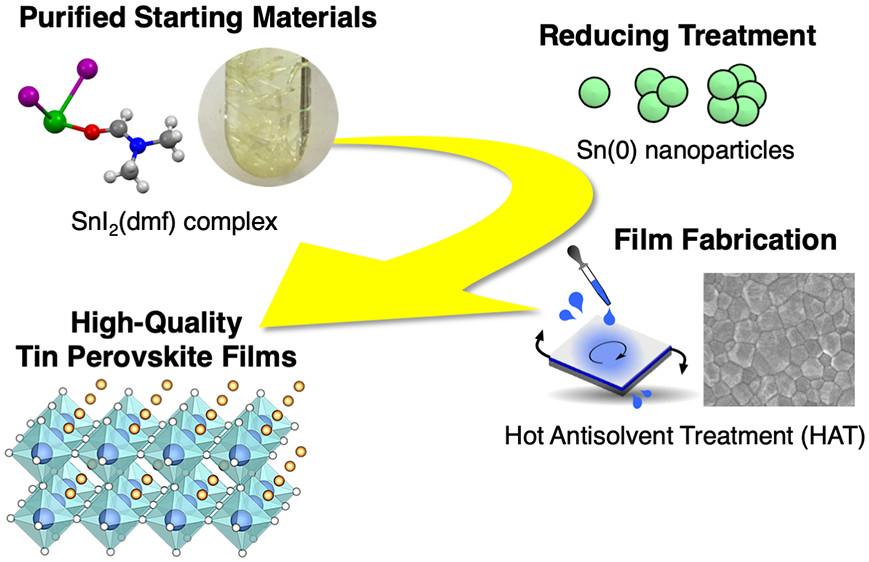
While conversion efficiency is continually improving, PSCs are also making strides toward commercialization. However, its structure contains Pb, a hazardous material, which contradicts the original aim of solar cells to save energy and protect the environment and impedes their commercialization. The goal of this article is to increase the device performance of lead-free tin-based PSCs, which are environmentally beneficial. In this research, SnF2 is initially precipitated in perovskite solution and employed as a heterogeneous nucleation site, which aids tin-based perovskite precipitation and growth into a flat and compact film following annealing. The lattice contraction of perovskite becomes increasingly visible as x increases, and the size of the unit cell of the film surface grows greater. The goal of this work is to x increase from 0 to 0.5, the performance of the device’s environmentally-friendly lead-free tin-based PSCs is 2.1% and VOC = 0.35 V when x = 0.5. In this research, SnF2 is initially precipitated in perovskite solution and employed as a heterogeneous nucleation site, allowing tin-based perovskite to precipitate quicker and more evenly, and then develop into a flat and compact film after annealing. As x increases, the lattice shrinkage of perovskite becomes more visible, and the unit cell size of the film surface grows bigger.